• Read Psalm 22

    MORNING— Ground Zero

    • Focal Passage: Psalm 22:1

    “My God, my God, why have You forsaken Me?  Far from deliverance are the words of my groaning.”

    There is a place in England that looks almost forgettable at first glance—a thin metal line set into stone on a hill at Greenwich. It marks zero degrees longitude. Ground zero. The place from which the world measures where it is.

    My old college professor, Lee Magness, described standing in this spot in “the place and time where time and place are set.” He said being there one might become a better person… “more secure about starting, starting over, starting out, on this planet, on this journey, on this self.”                                                           
    Psalm 22 brings us to ground zero of the Christian faith. The place where hope, suffering, sin, love, justice, and mercy all intersect. The place from which everything else must be measured.

    Written by David centuries before Rome perfected crucifixion, this Psalm yet reads like eyewitness testimony of Jesus’ crucifixion. Mocking voices. Bones out of joint. Thirst. Hands and feet pierced. Garments gambled for.

    When Jesus cried from the cross, “My God, My God, why have You forsaken Me?” He was not grasping for words in desperation. He was praying Scripture. In the first century, a rabbi who spoke the opening line of a psalm called the entire psalm to mind. Jesus was drawing Psalm 22 into that moment—inviting those who heard Him to see His suffering through God’s long-revealed purpose.

    What looked like chaos to onlookers was obedience. What sounded like abandonment was atonement. What appeared to be loss was the turning point of history.

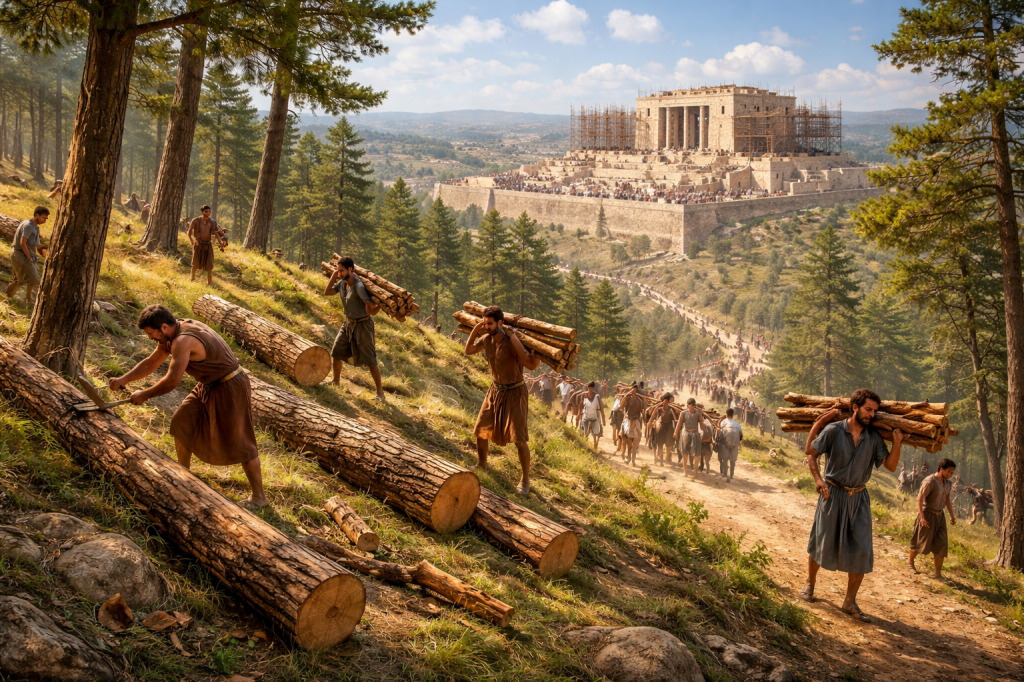
    God grew the tree that would bear the cross. He shaped the ore that would become the nails. From the garden where a tree became the place of humanity’s fall, to this hill where a tree became the instrument of redemption, God has been at work. The cross stands at the center of the forest of Scripture—the place where judgment and mercy meet, where sin is answered, where the story turns.

    Here, at this tree, the whole biblical story comes into focus.

    • Reflection:  What changes when you realize the cross is not a detour in Scripture, but the place where everything converges?

    EVENING— Were You There?

    • Focal Passage: Psalm 22:24

    “For He has not despised nor abhorred the affliction of the afflicted; neither has He hidden His face from him; but when he cried to Him for help, He heard.”

    Psalm 22 does not remain in anguish. It moves—deliberately—from suffering toward confidence, from isolation toward praise. And in doing so, it presses a hard question upon every reader: Where were you in this story?

    If you are honest, as you look in Scripture, either here or in the Gospels, and witness the agony of the Christ, you may at first only see Roman soldiers, religious leaders, and a hostile crowd. But look closely and you will see yourself, shaking your fist at the Lord.

    That realization unsettles us because it tells the truth. We were not neutral observers. Our sin required the cross. Our rebellion demanded that tree.

    And yet—this is the wonder of Psalm 22—Jesus did not respond with threats or curses. He prayed. He trusted. He entrusted Himself to the Father even when deliverance did not come immediately.

    The psalm turns. The verbs shift. “You answered Me.” (v. 21)
    Rescue is spoken of as already accomplished, even while suffering continues.

    This is where Psalm 22 looks beyond the cross—toward resurrection, toward proclamation, toward generations yet unborn who will hear what God has done. “They will declare His righteousness… that He has performed it.” (v. 31)

    The cross is not an isolated moment in Scripture. It is the central tree in God’s redemptive forest—the place toward which all earlier hope leaned, and from which all future life now grows.

    There is no Easter without Good Friday.
    But because of Good Friday the cross is no longer a place to flee from. It is a place to stand. A place to confess. A place to begin again.  Ground zero of our story.

    • Reflection:  When you look at the cross, do you see only suffering—or do you also see the place where God met you personally?
    • Closing Prayer:  Holy God, bring me again to the foot of the cross. Strip away illusion, pride, and distance. Help me see both my sin and Your mercy there. Let the tree of suffering become the place where my life is rooted in grace.
      Amen.
    • Read Psalm 8

    MORNING— God, You Do Good Work!

    • Focal Passage: Psalm 8:1

    “O LORD, our Lord, how majestic is Your name in all the earth.”

    You don’t have to be a folk-music fan, and you don’t have to like granola or wear hiking boots to understand why John Denver wrote Rocky Mountain High. All you need is a scenic turnout.

    Most of us have experienced it—driving through the Appalachians or the Rockies, rounding a bend, and suddenly the landscape opens up. Mountains lined up like they’re showing off their strength. Fog settled into the gaps. The sun lowering behind them, turning everything three-dimensional. You step out of the car, draw in the air, and without thinking you find yourself saying, “Wow.”

    Something akin to prayer.

    Psalm 8 was written by King David—not exactly a nature poet by reputation. Yet here he is, looking up at the night sky, and the only response that makes sense to him is praise:

    “O LORD, our Lord, How majestic is Your name in all the earth.”

    Why does creation do this to us? Why does beauty press us toward God?

    Some argue that it shouldn’t. Richard Dawkins once described the universe as nothing more than blind forces and pitiless indifference—no design, no purpose, no meaning. But that explanation doesn’t fit the experience. We don’t walk along a beach, find a detailed sandcastle shaped like the White House, and conclude it happened by accident. We look for the sculptor. And when we find them, we express admiration of their work.

    Creation is the most expansive work of art imaginable. It points beyond itself. It invites praise for the One whose fingers set the stars in place.

    David goes even further.

    “From the mouth of infants and nursing babes You have established strength…”

    God doesn’t just draw praise from mountains and galaxies. He draws it from the smallest voices. From children who don’t yet know the right words, but somehow know the right response.

    There is a story of a young girl raised in a home where God was never mentioned. One day she asked her father where the world came from. He gave her a material explanation, then added, “Some people believe it comes from a powerful being they call God.” The child burst into joy and ran through the house shouting, “I knew it wasn’t what you said—it’s Him!”

    From the mouths of babes.

    God delights in using what seems fragile to unsettle what appears powerful. He does not need brilliance or polish. He works through availability and wonder. And sometimes, when people hear creation speak and see praise rising from unexpected places, they find themselves drawn toward belief.

    • Reflection:  Have you recently let a sunrise, a mountain view, a quiet field, a starry sky lead you into praise… or did you only register it as a brief backdrop while hurrying on with your day?

    EVENING— Crowned with Glory

    • Focal Passage: Psalm 8:4

    “What is man, that You take thought of him?  And the son of man that You care for him?”

    If creation lifts our eyes upward, it also turns them inward.

    David looks at the heavens—the moon, the stars, the vastness arranged by God’s hand—and asks a question that has echoed through every generation:

    “What is man that You take thought of him?”

    Standing beside the ocean does that to us. Walking among redwoods does that to us. Being high on a mountain ridge does that to us. We feel small.

    That can be a gift.

    William Beebe once described an evening he spent with Theodore Roosevelt. After conversation, they stepped outside and searched the night sky until they located a faint smudge of light—the Andromeda Galaxy. One of them recited its scale: billions of suns, one among millions of galaxies. Roosevelt smiled and said, “Now I think we are small enough. Let’s go to bed.”

    Perspective has a way of restoring humility. It reminds us that we are not in charge, and never were.

    But there is another side to smallness. Vastness can also make us feel insignificant. David feels that tension. He uses the word enos—mortal, fragile man. Who am I, really?

    Creation alone can’t answer that.

    So God does.

    “Yet You have made him a little lower than God,
    And You crown him with glory and majesty.”

    Small—but not insignificant. Finite—but honored.

    Human beings are not animals with better instincts. We are image-bearers. We create. We imagine. We steward. God entrusted the world to human care and crowned us with responsibility and dignity.

    More than that, Scripture reveals something even greater. This psalm ultimately points beyond David. The New Testament tells us that Jesus—the true Son of Man—was made “a little lower than the angels” for a time (Hebrews 2:7). God entered His own creation. He took on weakness. He bore mortality. And through suffering, He restored what was broken.

    Creation shows us God’s greatness. Christ shows us our worth. That combination changes how we live.

    It is the invitation of Psalm 8.

    • Reflection:  Where has life made you feel small in ways that have drained your hope? How does God’s declaration of your worth reshape that feeling tonight?
    • Closing Prayer:  Majestic God, Your glory fills the skies, yet You attend to fragile people like us. Teach us to praise You through what You have made and to trust You with who You have made us to be. Restore our wonder. Anchor our worth in You. May Your name be honored in all the earth.
      Amen.
    • Read Psalm 2 & 3

    MORNING— The Noise of the Nations

    • Focal Passage: Psalm 2:12

    “How blessed are all who take refuge in Him.”

    Psalm 1 taught us to watch where we walk.
    Psalm 2 now asks us to watch what the world is doing.

    The psalm opens with commotion.

    Why are the nations in an uproar?

    This is the sound of rebellion. The nations rage. Their leaders gather. Their plans are coordinated. And their goal is clear: to throw off God’s rule. They speak of His commands as chains, His authority as restraint. They want freedom on their own terms.

    The language is telling. What is usually restrained with cords and fetters? Animals. The nations see God’s moral order as constricting.

    That posture has not disappeared. Our culture still celebrates rebellion as virtue. “Born to be Wild” plays like an anthem for independence without limits. The world often feels as though it is tilting toward chaos. Someone once joked, “Shall we watch the six o’clock news and get indigestion, or wait for the eleven o’clock news and have insomnia?” The noise never seems to stop.

    Psalm 2 gives us God’s perspective.

    While the nations are scheming, God is seated. While they rage, He laughs—not out of mockery, but because their resistance cannot alter His purpose. Like watching someone attempt something far beyond their strength, God sees the futility of opposing His plans.

    But laughter gives way to warning.

    “As for Me, I have installed My King.”

    God has already acted. His Messiah is in place. Resistance will not stand.

    There is comfort here for the believer. We are not to be intimidated by the plans of this world. Scripture calls them vain—empty, unable to succeed. At the same time, Psalm 2 speaks personally: do not tear at your own yoke. It is a hollow freedom to break away from the One who gives life.

    The psalm closes with an invitation that holds everything together:

    “How blessed are all who take refuge in Him!”

    In a world at war with God, refuge is the wisest response.

    • Reflection:  What would it look like today to take refuge in Christ? Do you get away to get under His protection often enough?

    EVENING— The Sleep of Trust

    • Focal Passage: Psalm 3:5

    “I lay down and slept; I awoke, for the Lord sustains me.”

    Psalm 3 brings the conflict closer to home.

    This is the first psalm with a title, and the story behind it is painful. David is fleeing from his son Absalom, who has nearly succeeded in overthrowing him. This is rebellion not among nations, but within a family. E. M. Blaiklock called Psalms 3–6 “Psalms of the Great Rebellion.”

    Yet you do not need a crown or a coup to recognize yourself here. Psalm 3 is also the first individual lament.

    David begins where honesty begins—with a cry.

    “O LORD, how my adversaries have increased!”

    He names the situation as it stands and gives voice to the pressure bearing down on him. Then he puts words to what wounds most deeply—what people are saying.

    “There is no deliverance for him in God.”

    Words lodge in the soul. They can undo us faster than circumstances. A suicide note once contained only two words: “They said.”

    David answers those voices by turning his attention back to God.

    “But You, O LORD, are a shield about me.”

    David does not explain why he deserves rescue. He focuses on who God is. God is his shield. God is his glory. God is the One who lifts his head when shame presses it down. Picture God placing His hand under your chin and saying, “Look up. You’re going to make it.”

    Then comes one of the most arresting lines in Scripture:

    “I lay down and slept.”

    Surrounded by enemies. Betrayed by his son. Hunted by his own people. And yet—sleep.

    Anxiety would have kept David alert through the night, but faith allowed him rest. David believed God was awake, so he did not have to be.

    That kind of rest reminds me of a simple practice shared by a mother in Minnesota. Each night, as she tucks her two young daughters into bed, she says the same words: “Remember, you are special to God. Remember how much we love you. Sleep loose.”

    She chose that phrase intentionally. She wanted her children to release their grip on fear, to rest inside the love that surrounds them. Too many of us—children and adults alike—sleep tight, muscles clenched, hearts braced for whatever might come next. It is hard to rest when you are always ready to run.

    David slept because he knew where his safety lay. He rested because he believed he was known, loved, and guarded by God. That kind of confidence loosens the soul.

    Tonight, like David, you are invited to sleep loose—not because danger has vanished, but because the Lord who watches over you has not.

    • Reflection:  What voices have been stealing your rest? How might leaning into trust cause you to sleep loose tonight?
    • Closing Prayer:  Father, when the world rages and the noise grows loud, teach me to run to You for refuge.  When words wound and fear presses in, remind me that You are my shield.  I rest in you. Amen.

    • Read Psalm 1🌳

    MORNING— Rooted in the Word

    • Focal Passage: Psalm 1:1-2

    “How blessed is the man who does not walk in the counsel of the wicked, nor stand in the path of sinners, nor sit in the seat of scoffers. But his delight in in the law of the Lord and in His law he meditates day and night.”

    The first three Psalms are tied together by the English words:  Blessed or Blessing.  Psalm 1:1; 2:12; 3:8

    The word for blessed in Psalms 1 & 2 is ‘asher.  Charles Swindoll states:  “Blessed” is somewhat bland in our English language.  The Hebrew word is much more descriptive, especially with its plural ending.  Perhaps a workable rendering would be, “Oh, the happiness, many times over.” The word in Psalm 3:8 is the word Bᵉrâkâh:  a gift, a present, prosperity.  Who wouldn’t want “happiness, many times over” and “prosperity” from the Lord?

    The best way there according to Psalm 1 is to “watch where you walk.”  We see throughout this Psalm: two roads.  One road leads to a blessed state or happiness (v.1).  The other road leads to a state of perishing (v. 6).  Choose wisely.

    The blessed chose good company for their journey. 

    How blessed is the man who does not walk in the counsel of the wicked, Nor stand in the path of sinners, Nor sit in the seat of scoffers!

    Witness the digressions… all in this one verse.

    Walking to Standing to Sitting.

    Accepting their counsel to going along to get along to sitting among them.

    It is a horrifying day when a parent has to acknowledge that their child isn’t merely hanging out with the wrong crowd.  They ARE the wrong crowd!  One other digression is pointed out by Charles Spurgeon:  one from Wicked (careless or ungodly), to Sinner (one openly sinning) to mockers (one openly ridiculing the righteous).

    So how does the blessed individual avoid these digressions?  By reading, studying and meditating on God’s word.  Actually by delighting in it.  

    When we fall in love with the Bible’s author—it becomes personal.

    There is a difference between reading a used book with a random note scribbled in the margin and opening a book with a handwritten note from someone you love. One barely holds your attention. The other slows you down because it was meant for you.

    When the Bible is seen as a letter from God—not to humanity in general, but to you—everything changes. Prayer and Scripture begin to work together. Delight grows where duty once dominated.

    God’s Word becomes oil in the engine of a blessed believer. It keeps the heart from seizing up. It keeps one moving in the right direction.

    And it helps you watch where you walk.

    • Reflection:  Do you have a method of getting God’s word into you? What delights have you found in His Word today?

    EVENING— Planted by the Stream 🌳

    • Focal Passage: Psalm 1:3

    “He will be like a tree 🌳 firmly planted by streams of water, which yields its fruit in its season and its leaf does not wither; And in whatever he does, he prospers.”

    After warning us where not to settle, Psalm 1 shows us where life is meant to take root.

    🌳 A tree firmly planted by streams of water.

    This tree 🌳 did not arrive by accident. It did not place itself. It was planted—set where nourishment is steady and dependable. Its strength does not come from appearance or effort alone, but from where it draws life.

    The righteous person delights in God’s Word because it has become a source of life. It shapes judgment, steadies the heart, and anchors decisions. Over time, fruit appears. Leaves remain green because the supply does not fail.

    The wicked, by contrast, are described as chaff—unrooted, weightless, and unable to stand when pressure comes. They move easily and attract attention, but they cannot endure.

    Psalm 1 leaves no ambiguity.

    It begins with the word “Blessed.”
    It ends with the word “Perish.”

    Those are not poetic flourishes. They are destinations.

    John 3:16 echoes the same dividing line:

    “For God so loved the world that He gave His only begotten Son, that whoever believes in Him shall not perish, but have eternal life.”

    To be planted by God is to belong to Christ—to be forgiven, rooted in grace, and given life that endures judgment. To refuse that planting is to remain exposed when the winds come.

    Psalm 1 stands at the entrance to the Psalms and asks the question:

    Where is your life planted?

    • Reflection:  Have you trusted Christ to set you on the way of the righteous?  Are you meditating on your road map?
    • Closing Prayer:  Lord, every so often I drift.  Help me watch my steps and my company.  Help me to delight in Your Word by delighting daily in You.  Help me to flourish where You have planted me. Amen.

    • Read Job 42

    MORNING— Now My Eyes Sees You

    • Focal Passage: Job 42:1-6

    “Then Job answered the LORD and said, “I know that You can do all things, and that no purpose of Yours can be thwarted… I have heard of You by the hearing of the ear; But now my eye sees You; Therefore I retract, and I repent in dust and ashes.””

    Pro-golfer Tommy Bolt, famous for his temper, once missed six straight putts in a match. He shook his fist toward heaven and shouted,
    “Why don’t you come down and fight like a man?”

    That had been Job.

    He challenged God’s fairness, questioned His governance, and demanded his time before the Judge to lay out his case. Then God spoke from the whirlwind. And when Job finally stood before Him, he did not present a single piece of evidence or offer one legal argument—he simply repented.

    As the Bible Knowledge Commentary comments:  “To attack God, to malign Him, challenge Him, accuse Him, bait Him, or try to corner Him—all of which Job did—are out of the question for a believer. To criticize God’s wisdom only shows one’s own ignorance. The chasm between God and man leaves no place for pride and self-sufficiency.

    Ultimately, without excuse, Job acknowledges what God’s speeches were designed to teach him. God is all-powerful. Nothing frustrates His purposes. Even justice for the suffering—delayed, hidden, unresolved—rests securely in His hands.

    Job repeats God’s own words. “‘Who is this that hides counsel without knowledge?’” Counsel refers to God’s designs and purposes. What Job once challenged, he now confesses he never fully understood.

    “I have heard of You by the hearing of the ear;
    But now my eye sees You.”

    Job had known about God. Now he had encountered Him.

    “Therefore I retract,
    And I repent in dust and ashes.”

    Repentance here is not despair—it is humility. The Hebrew word (nācham) carries both regret and consolation. In recognizing what he truly is—dust and ashes—Job finds relief.

    Dust thrown into the air.
    Ashes sat among.
    Both signs of surrender.

    In laying down his case, Job finally finds rest.

    • Reflection:  Where have you been demanding explanations when trust was required? What would it look like today to lay down your case and listen?

    EVENING— My Servant Job

    • Focal Passage: Job 42:7-10

    “My wrath is kindled against you… because you have not spoken of Me what is right as My servant Job has.”

    After the Lord finished speaking to Job, He turned to Eliphaz—and His words were severe.

    “My servant Job” is spoken four times in two verses.

    The three friends believed they were speaking for God. They were confident, articulate, and wrong. Job, for all his anguish and unfiltered speech, had spoken more faithfully than those who tried to defend God with tidy theology.

    The Hebrew word translated “right” can also mean established. God appears to commend Job for taking the risk of honesty—of bringing his pain directly to God rather than reshaping God to protect his assumptions.

    Job was right about one central truth: he had not committed a sin deserving this level of suffering. His friends were wrong to insist that suffering must always be tied to hidden guilt.

    John Calvin summarized it this way:
    “Job’s friends pled a bad case well. Job pled a good case poorly.”

    God then required a staggering sacrifice—seven bulls and seven rams—a public acknowledgment of how seriously He takes misrepresentation. The men who wounded Job must now approach him.

    And Job becomes the mediator.

    The man who cried out for one is now asked to be one.

    “My servant Job will pray for you… and I will accept him.”

    When Job prays for his friends, the Lord restores his fortunes.

    This restoration is often misunderstood. Some argue the ending undermines the book, as if repentance produced prosperity and proved the friends right. But verse 11 reminds us that Job continued to grieve. Comfort did not erase loss.

    Why is this ending fitting?

    Because it marks the end of the real battle. Satan’s wager failed. Job proved that a person can love God simply because He is God, not because obedience guarantees reward. Once Job understood that his righteousness did not obligate God, he was finally free to receive God’s gifts without confusion.

    And yet, Job does not provide the final answer to suffering.

    God Himself stepped into the problem of pain.

    “For it was fitting… to perfect the author of their salvation through sufferings.” (Hebrews 2:10)
    “We do not have a high priest who cannot sympathize with our weaknesses…” (Hebrews 4:15)
    “Fixing our eyes on Jesus… who endured the cross.” (Hebrews 12:2)

    In Jesus, God identified with sufferers by suffering.
    In Jesus, God sympathizes with weakness.
    In Jesus, we are invited to the throne of grace.

    • Reflection:  What would change if you trusted God’s presence more than your ability to understand His ways?
    • Closing Prayer:  Lord, You are able to do all things, and no purpose of Yours can be thwarted. Forgive us for speaking beyond our understanding and for trying to explain what You ask us to trust.  Thank You for drawing near to us in Jesus Christ.  We find rest in your mercy.
      Amen.
    • Read Job 38; 40:1-5

    MORNING— A Whirlwind of Question Marks

    • Focal Passage: Job 38:1-3

    “Then the LORD answered Job out of the whirlwind and said, ‘Who is this that darkens counsel
    By words without knowledge?  Now gird up your loins like a man, and I will ask you, and you instruct Me!”

    Gary Larson once drew a Far Side cartoon imagining God competing with a human contestant on a television game show. The set suggests a fair contest—buzzers, podiums, bright lights—but the scoreboard tells the truth: God is winning 1065 to 0. We laugh at such a ridiculous contest. God is, of course, the hands-down winner, and we are foolish to think we could even compete. Larson captures the same mistake God confronts in Job—the belief that the Creator can be summoned, challenged, or measured as though He were a peer.

    That moment arrives in Job 38.

    After chapters of anguish, accusation, and unanswered prayer, the LORD answers Job out of the whirlwind. The word translated whirlwind appears elsewhere as tempest or windstorm. Earlier in Job’s story, a mighty wind brought devastating loss. Now, another wind brings revelation. As one commentator observed, the first storm produced sorrow; this one produces submission.

    God does not answer Job’s questions. Instead, He questions Job.

    “Who is this that darkens counsel by words without knowledge?”

    Job had insisted that God explain Himself. He had demanded a hearing. He had even signed his complaint. And now God speaks—with authority. “Gird up your loins like a man,” He says. Prepare yourself. This will not be a conversation among equals.

    Then comes the firehose.

    “Where were you when I laid the foundation of the earth?”
    “Who set its measurements?”
    “Who shut in the sea with doors?”

    The earth is pictured like a building under construction. The sea like a newborn, wrapped in swaddling bands of cloud and darkness. Morning stars sing. Angels shout for joy. God moves from creation’s heights to its depths, from dawn and darkness to snow and hail, lightning and rain. He asks Job if he commands the morning, if he knows where light dwells, if he has walked through the gates of death.

    The point is not humiliation for its own sake.
    The point is perspective.

    John Fischer once noted that the book of Job is filled with question marks—many spoken by Job, many by his counselors. But when God finally speaks, He does so with seventy-eight questions of His own. Sometimes God answers us not with explanations, but with questions that leave us humbled, awed, and believing—not because we’ve solved the mystery, but because we’ve seen God.

    Job wanted answers.
    God gave him Himself.

    • Reflection:  How often do you approach God as if you’re on equal footing—asking, arguing, demanding—rather than standing in awe of who He is?

    EVENING— A Hand Over Mouth Moment

    • Focal Passage: Job 40:3-5

    “Then Job answered the LORD and said, ‘Behold, I am insignificant; what can I reply to You?
    I lay my hand on my mouth.  Once I have spoken, and I will not answer; Even twice, and I will add nothing more.’”

    After questioning the cosmos, God pauses—and turns back to Job.

    “Will the faultfinder contend with the Almighty?”

    For the first time, Job stops talking.

    The man who once told others to clap their hands over their mouths now places his own hand there. Not in despair, but in reverent silence.

    Job admits what suffering has been trying to teach him all along: “I am insignificant.” Never again will he approach God like a stately prince demanding explanations. He has learned the posture of humility.

    God graces Job by meeting him in the middle of his confusion. As H. H. Rowley observed, Job found relief not from his misfortunes, but in them—because he found God there.

    That is the miracle of Job 38–40.

    The wonder is not that God explains suffering.
    The wonder is that God speaks at all.
    The wonder is that He does not separate Himself from the sufferer.

    And when He does speak, the right response is not argument, but awe.

    Once we stop trying to run the game, we discover the relief of not being in charge.

    • Reflection:  What would change if you trusted God’s presence more than your ability to understand His ways?
    • Closing Prayer:  Lord God, You set stars in their place and even know them by name and yet You draw near to those who suffer.  Forgive us for demanding answers when what we need most is Your nearness. Teach us when to speak—and when to be still. Help us rest in the relief of not being in charge. You are amazing, O God.
      Amen.
    • Read Job 14 & 19

    MORNING— At the Scent of Water 🌳

    • Focal Passage: Job 14: 7, 9

    “For there is hope for a tree, when it is cut down, that it will sprout again… at the scent of water it will flourish.”

    Suffering has a way of turning our thoughts toward mortality.

    Job looks at the natural world and notices something unsettling. A tree can be cut down to a stump, its roots aged and buried in dry soil, and yet—given water—it lives again. In the ancient Near Eastern world, this was not sentimental poetry but observed reality. Trees 🌳 in arid regions could appear completely dead: cut down, roots dried, stump lifeless. And yet when moisture returned, even a trace of water in the soil could trigger new growth.

    The tree 🌳 does not need a flood.
    A suggestion of water is enough.

    The Hebrew image emphasizes sensitivity and responsiveness—life awakening at the faintest hint of provision. At the scent of water, the tree stirs. Shoots push upward. What looked finished is not.

    Job sets that image against human life.

    As water slowly drains from the sea and a river thins until it runs dry, so human life ebbs. Strength fades. Breath lessens. Time slips away. And once a person lies down in death, they do not rise—at least not within the visible order of this world. From Job’s vantage point, trees appear more resilient than people.

    That contrast sharpens his lament.
    Trees 🌳 revive with minimal hope.
    Humans seem far more fragile—dependent on a hope that lies beyond what can be seen.

    And yet, even here, Job does not let go completely. He asks whether a man who dies will live again, and then answers himself—not with certainty, but with resolve: all the days of my struggle I will wait, until my change comes.

    Job does not yet speak clearly of resurrection. But he waits. And waiting, in this chapter, is faith holding on by its fingertips. Life may feel reduced to a stump. Hope may be almost imperceptible. But Job believes—however faintly—that change will come.

    “At the scent of water” becomes more than a botanical observation.
    It is an image of life rising again when hope can barely be detected.

    • Reflection:  When hope feels almost imperceptible, what helps you recognize the “scent of water” God is providing?

    EVENING— My Redeemer LIVES

    • Focal Passage: Job 19:25

    “As for me, I know that my Redeemer lives.”

    Earlier, Bildad had reached for tree 🌳 imagery to explain Job’s suffering. He spoke of the wicked as trees whose roots dry up below and whose branches wither above—cut off, finished, forgotten (Job 18:16). It was meant as a warning.

    By chapter 19, Job has absorbed that image—and turned it inward. He says his own hope has been uprooted like a tree 🌳, torn from the ground, exposed, dying (Job 19:10). What Bildad used as a warning, Job experiences as a reality.

    But Job does not stop there.

    Suddenly, the book pivots. Out of pain and isolation, Job speaks words he wants preserved forever: “Oh that my words were written… engraved in the rock” (Job 19:23–24). Look down at your Bible for a moment. His request was granted.

    Then comes one of the most astonishing confessions in the Old Testament: “As for me, I know that my Redeemer lives, and at the last He will take His stand on the earth” (Job 19:25). The “I” is emphatic—I, even I, know. This is intimate, hard-won conviction.

    The word Redeemer is goel—the nearest relative who stepped in to rescue, defend, or reclaim what was lost. Job has already given up on human advocates. His Redeemer must be someone greater—someone who can stand between him and God, someone who will still be standing at the last. This Redeemer cannot die.

    Job presses even further. “Even after my skin is destroyed, yet from my flesh I shall see God” (Job 19:26–27). After death. From his own flesh. With his own eyes. This is resurrection language—spoken centuries before Easter morning.  Job declares that his hope does not merely survive suffering—it survives death.

    The thought overwhelms him. His heart faints within him.

    What Job sees dimly, we see clearly. This Kinsman-Redeemer is Christ. Through Him, Peter writes, we are born again to a living hope through the resurrection of Jesus Christ from the dead (1 Peter 1:3).

    The worst-case scenario in suffering is death itself. Job stares that reality down—and refuses to let it have the final word.

    Hope will not end at the grave.
    It passes through it.

    The hope our Redeemer brings is living, certain, and stronger than death.

    • Reflection:  How does the promise of resurrection through Christ reshape the way you face even the worst possible outcome?
    • Closing Prayer:  Redeeming God, when our lives feel reduced to stumps and our hope feels faint, train us to wait for the scent of water. Root us deep in Christ, our living Redeemer.  Amen.
    • Read Job 3 & 4

    MORNING— Cursing the Day You Were Born

    • Focal Passage: Job 3:1

    “Afterward Job opened his mouth and cursed the day of his birth.”

    Job does not curse God.
    He curses the day.

    That matters.

    Satan’s objective was never simply to make Job suffer—it was to provoke him into renouncing God. And here, in what may be the darkest chapter of the book, Job does not do it. His words are raw, poetic, and unfiltered, but they are still spoken to God, not against Him.

    Job wishes the calendar itself could be undone. He imagines the lights going out on the day of his conception, the sun swallowed by darkness, dawn never breaking. Hebrew “wish verbs” fill the chapter—may this, let that—revealing not intention but longing. Job is not plotting his death. He is grieving his existence.

    This may well be one of the most depressing chapters in the Bible. It offers no promises. Few sermons are made from it. And yet God did not remove it from Scripture. He preserved it.

    Scott Sauls tells of encountering a suicide note written by a pastor—faithful, gifted, well-known—who described depression like drowning, gasping for one more breath. The note closed with words that still confessed Christ as “Our Only Hope in Life and Death.” That tension—faith still present, hope barely breathable—is closer to Job 3 than we are often able to admit.

    We are often uncomfortable with that tension. We want lament softened, edited, or resolved. We want people to “tone it down.” But Job is allowed to speak. God does not silence him.

    Lament is not unbelief.
    It is faith refusing to pretend.

    • Reflection:  Do you allow yourself—and others—to speak honestly before God, or do you hurry grief toward resolution before it has finished telling the truth?

    EVENING— When Helping Hurts

    • Focal Passage: Job 4:2

    “If one ventures a word with you, will you become impatient?  But who can refrain from speaking?”

    Eliphaz means well.
    That may be the most troubling part.

    He listens to Job’s anguish—and then explains it. Innocent people don’t suffer, he says. Trouble has causes. Pain has explanations. If something this devastating happened, something must have gone wrong. What did you do, Job?

    Eliphaz even brings spiritual credentials. A vision. A whisper in the night. A truth that sounds orthodox: No one is righteous before God. The problem is not that Eliphaz believes false things—it’s that he applies true things at the wrong time, to the wrong person, for the wrong reason. Wisdom applied without discernment becomes cruelty. He speaks less to comfort Job than to protect his understanding of how the world should work.

    Know someone who is in a Job-like state right now?  The most important think you can do for them is to let them know they are seen by God.  And that His desire is to comfort them.

    “The LORD is near to the brokenhearted
    And saves those who are crushed in spirit.”

    Psalm 34:18 (NASB 1995)

    It can feel as though God is hidden. Job feels that keenly. But Scripture insists otherwise. Nearness is not always perceptible, but it is promised.

    So, veer from the tired, false theology of Eliphaz. Be there. Encourage. Comfort. Resist the urge to explain what you cannot see. Do not assign motives—to the sufferer or to God. You cannot see behind the curtain of their life, nor behind the curtain of the cosmos.

    • Reflection:  When someone is suffering, do you rush to explain God—or do you slowly encourage them to feel His comfort ?
    • Closing Prayer:  Lord, You are near to the brokenhearted, even when You feel far away. Teach us how to lament honestly without losing faith, and when darkness feels louder than hope, keep us from quitting—keep us close to You.
      Amen.
    • Read Job 2

    MORNING— Will We Accept Good Only?

    • Focal Passage: Job 2:10

    “Shall we indeed accept good from God and not accept adversity?”

    Job’s suffering is not finished. Job 2 opens with a scene that feels painfully familiar. Once again, the sons of God present themselves before the LORD. Once again, Satan appears. Once again, God points to Job.

    Job has already lost his children, his wealth, and his standing. Yet God says something striking:

    “He still holds fast his integrity, although you incited Me against him to ruin him without cause.” (Job 2:3)

    That phrase can stop a reader cold. Didn’t Satan do these things?
    Yes. He did.

    But by granting permission, God takes responsibility for what is allowed. Scripture is not saying God caused evil. It is saying God never surrendered control. This is sovereignty—not the idea that God does everything, but that nothing happens outside His authority.

    Satan argues that Job’s faith has not yet been tested at its core. He believes Job endured loss only because his health remained intact. Touch the body, Satan claims, and devotion will fail.

    Once again, God sets limits. “Behold, he is in your power, only spare his life.” (Job 2:6)

    Even here, suffering is not unrestrained. Satan is powerful, but never autonomous.

    What follows is a descent into physical agony. Job is struck with painful boils from head to foot. He sits among the ashes, scraping his skin with a broken piece of pottery. There is no relief. No sleep. No escape. If you have ever found yourself in that place—where pain lingers and questions multiply—you understand why Scripture lingers here.

    Job’s wife speaks from her own grief. She has buried ten children. She has lost security, stability, and the companion she once knew. Her words are raw, not calculated: “Do you still hold fast your integrity? Curse God and die!” (Job 2:9)

    Job answers with clarity and restraint: “Shall we indeed accept good from God and not accept adversity?” (Job 2:10a)

    Scripture’s verdict is clear:  “In all this Job did not sin with his lips.” (Job 10b)

    Job does not deny pain. He does not pretend suffering is good. But he refuses to allow hardship to redefine who God is.

    • Reflection:  When suffering deepens rather than resolves, what expectations of God are exposed in your heart?

    EVENING— What Job’s Counselors Did Right

    • Focal Passage: Job 2:13

    “Then they sat down on the ground with him for seven days and seven nights with no one speaking a word to him, for they saw that his pain was very great.”

    Job has reached the lowest point of his suffering. His body is broken. His grief is overwhelming. His wife’s words cut deeply. And into that moment step three friends: Eliphaz, Bildad, and Zophar.

    We remember them for the arguments they will eventually make, but it is easy to forget that in chapter 2 they get several important things right—things that still matter in moments of real grief today.

    1. They came.  “They came each one from his own place…” (v.11)  Many people retreat when suffering appears. These men traveled to be with Job. Presence is a ministry long before words ever become one.

    2. They came with compassion.  “…to sympathize with him and comfort him.” (v.11) Their intent was good. Their hearts were engaged. Their first instinct was not correction—it was solidarity.

    3. They allowed themselves to feel the loss. “They raised their voices and wept…” (v.12)  This is rare. Some try to stay composed around grief, as though strength is shown by emotional distance. Job’s friends let themselves break open with him.

    4. They sat with him. “They sat down on the ground with him…” (v.13)  Not above him. Not apart from him. On the ground, where pain had taken him. Shared posture is shared burden.

    5. They stayed as long as the moment required. “…for seven days and seven nights…” (v.13)  Grief has no stopwatch. They gave Job time before giving Job advice.

    6. They held their tongues. “…no one speaking a word to him…” (v.13)  Before their speeches went wrong, their silence went right. Most of the harm they will later cause comes not from their presence but from their explanations. For this first full week, they speak nothing—and it is the wisest they will ever be.

    7. They saw the depth of his pain. “…for they saw that his pain was very great.” (v.13)  They did not minimize it. They did not dismiss it. They acknowledged its size. Sometimes the most healing words are not explanations but simple honesty: “This is terrible. I see it.”

    Early in his medical career in India, Dr. Paul Brand cared for a baby girl named Anne, the child of missionary parents. Despite devoted care, she did not survive. Brand wept openly with the family, carrying a deep sense of failure as a physician.

    More than thirty years later, Anne’s father, now a pastor in Kentucky, introduced Brand to his congregation simply as “the doctor who cried at our Anne’s funeral.” The family did not remember a surgeon who failed, but a man who stayed and shared their grief.

    Job’s friends will eventually speak poorly, think wrongly, and wound deeply. But here—at the beginning—they model something we often forget: 

    Sometimes the most spiritual act is simply to sit down beside someone whose world has collapsed and stay long enough for them to know they are not alone.

    • Reflection:  When someone around you suffers, do you rush to speak—or do you offer the kind of presence Job received in his first seven days of sorrow?
    • Closing Prayer:  Holy God, teach us to trust You when suffering deepens and to stay with one another when words fail.  Shape us into people whose presence reflects Your compassion, and hold us steady when life places us in the ashes.
      Amen.
    • Read Job 1

    MORNING— A Good Man, A Hard Test

    • Focal Passage: Job 1:1

    “There was a man in the land of Uz whose name was Job; and that man was blameless, upright, fearing God and turning away from evil.”

    Years ago, I was standing in a checkout line at the grocery store. The man in front of me had only two items: a book titled Where Is God When It Hurts? and a six-pack of beer. The contrast caught my attention, so I commented on it.

    He looked back and said, “I figured either one or the other would help.”

    Then adding, almost as an afterthought, “I don’t know why my grandson doesn’t love me anymore.”

    The pain on his face has stayed with me ever since.

    We meet people with questions like that more often than we realize. Sometimes those questions are spoken aloud. Other times they are carried into the night, waking us when sleep should come. When suffering presses in, many turn to whatever might dull the ache. Others—sometimes even those with no faith background—reach for the book of Job.

    Not because it explains everything, but because it takes pain seriously.

    Job’s story opens without a date or a familiar location. Uz is not Israel. Job is not introduced as a covenant figure. That lack of specificity is intentional. Suffering does not belong to one culture, one generation, or one kind of person.

    Job himself is described as blameless. The Hebrew word tam does not mean sinless. It describes a life that is whole and sincere, without hidden compartments. Job feared God. He turned away from evil. His faith shaped how he lived, how he worked, and how he cared for his family.

    For a season, life followed the pattern Proverbs often describes.

    Job had children.
    He possessed great wealth gained honestly.
    He was respected among his peers.
    He prayed consistently for his sons and daughters.

    In a skeptical world, we expect a flaw. Someone so steady must be hiding something. Scripture removes that suspicion quickly.

    God Himself draws attention to Job.

    “Have you considered My servant Job?” (Job 1:8)

    Job is neither warned nor corrected. He is commended. That is what makes what follows so unsettling. Satan challenges the sincerity of Job’s faith, arguing that devotion thrives because protection surrounds it. Remove the hedge, he claims, and faith will collapse.

    The hedge was real.
    And the hedge came down.

    This does not happen because God stops caring. It happens because faith is about to be tested in a way prosperity never could. The opening of Job does not rush us toward answers. It slows us down long enough to ask what suffering reveals about the faith we carry into it.

    • Reflection:  When pain enters your life, where do you instinctively reach for help?  And what questions surface that you may not yet have words for?

    EVENING— Enduring Faith When it Hurts the Most

    • Focal Passage: Job 1:20

    Then Job arose and tore his robe and shaved his head, and he fell to the ground and worshiped.

    The losses come without pause.

    Four messengers arrive in succession. Each report compounds the last. Before grief can settle, it is overtaken by more devastation. By the end of the day, Job has lost his livelihood, his servants, and his children.

    Scripture does not soften the moment.

    Job responds physically and visibly. His robe is torn. His head is shaved. His body reflects what has been taken from him. Then he falls to the ground and worships.

    “Naked I came from my mother’s womb,
    And naked I shall return there.
    The LORD gave and the LORD has taken away.
    Blessed be the name of the LORD.” (Job 1:21)

    Job does not yet know what the reader knows. He is unaware of the heavenly exchange. He does not understand the scope of what has been permitted. Even so, Scripture offers a clear evaluation:

    “Through all this Job did not sin nor did he blame God.” (Job 1:22)

    That assessment matters.

    Diane Komp, a pediatric oncologist, once asked a grieving father during a stalled bone marrow search, “What kind of terms are you and God on these days?”
    He paused before answering, then said, “You really went to the heart of the matter.”

    That question reaches the core of Job. Reading his story is to examine faith under pressure.

    In the aftermath of tragedy people are not chiefly asking for airtight explanations or theological debates. They are asking where they can bring their grief without being corrected, rushed, or told to move on. Job provides that space. He grieves openly. He does not deny pain or minimize loss. At the same time, he, at least in chapter 1, refuses to place God in the dock as the accused.

    Augustine once wrote that the same fire refines gold and consumes straw. The difference lies not in the trial itself, but in what the trial reveals.

    Before the debates with friends begin.
    Before the questions multiply.
    Before God speaks from the whirlwind.

    Job’s faith endures.

    • Reflection:  When suffering removes stability and explanation, where does your faith settle?
    • Closing Prayer:  Faithful God, You are present when life is full and when it is stripped bare. Teach us not to measure Your goodness by our circumstances or Your faithfulness by our comfort.  When grief overwhelms us, draw us toward worship.
      Amen.